Kava is a root, water, and about three thousand years of practice.
Hawaiian 'awa is the same plant: Piper methysticum, a pepper relative grown across the Pacific. Where it grows, which part is used, how it gets from a field to a jar, and how to tell good from ordinary before you buy.
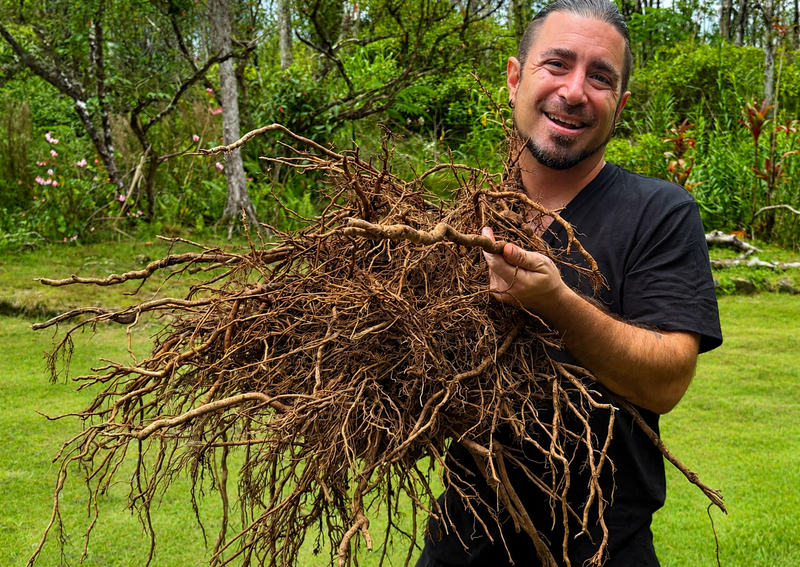
Origin is the first quality signal in this category.
Kava has been grown and prepared for centuries across Fiji, Vanuatu, Tonga, Samoa and Hawaii. Growers in each place selected their own cultivars for their own conditions, so where a root came from tells you more about what is in the jar than any adjective on a label.
Over 90% of Heartlight's kava is grown on the Big Island of Hawaii, and is pressed at our own lab there. Not blended from whatever was available that month.
Only one part of the plant is worth anything.
The plant comes out of the ground whole, but its parts are not equal and they do not cost the same. This is where a supplier working to a price makes its quiet decisions. We press the waka and the basal root only.
Waka, the lateral root
The fine roots that branch out sideways. Traditionally the prized material, naturally richest in kavalactones, and the most expensive part of the plant to harvest. We use it.
The basal root
The root ball at the centre of the plant. Also rich, also used by us, and the part where a supplier cutting cost will quietly increase the ratio against the waka.
Stems, bark and leaves
Not part of traditional preparation. Their presence is the clearest single indicator of a product built to a price. Removing them is slower than not removing them, which is the whole point.
Noble is a category, not a compliment.
Kava is propagated from cuttings, never seed, so a named strain is a continuous line rather than a description. Growers across the Pacific selected particular cultivars for traditional daily use over centuries; those are the noble varieties. Most of this industry blends several into one product. We do not: we name the three we grow.
Mahakea
The balanced one. Moderate strength, noble, and the strain to start on if you have not had a resin before.
Isa
Our heaviest extract, and the strain with an argument attached to it: it sits outside the noble list, so it gets called things. It also matures in about three years instead of five, which is what makes a Hawaiian supply of it realistic. We wrote a whole page on that.
Nene
The lightest and most cerebral of the three, noble, harvested in limited quantity. When it is gone it is gone until the next lift.
Field to jar: seven stages, no shortcuts worth taking.
These are numbered because the order carries information. Nothing else on the site is.
01 - Grown
A multi-year crop: roughly five years for the noble varieties, about three for Isa. Maturity at harvest is a quality variable, not a schedule, and it is the reason a supply chain this small has to be planned years out.
02 - Harvested
The root is lifted whole, then separated at once: waka and basal root kept, stems and bark set aside.
03 - Cleaned and dried
Washed and dried to a target moisture. Poor drying is where most problems in this category start.
04 - Verified
Strain and plant part are confirmed on intake, before anything is pressed. A single-strain claim is only worth something if it is checked here.
05 - Pressed
A solventless press and a water-based process, at our own lab in Hawaii. No solvent goes in, so nothing has to be chased back out.
06 - Tested
Independent, third-party lab testing for identity and kavalactones, heavy metals and microbial safety.
07 - Packed
Sealed, lot-stamped and dated at packing.
Same root, different jobs.
Format is a question about how a serving gets measured and carried. It is not a question about what the material is: both come off the same press.
Gummies
A fixed serving, already measured, in counts of 8 and 50. Each is formulated to roughly the kavalactone content of a traditional 8 oz bowl. The format for someone who wants to be exact without weighing anything.
Resins
Full-spectrum, dosed by you rather than by us, and specified to a minimum of 87% kavalactone content by weight. That is a potency specification, not a claim about how it will feel. One gram is formulated to roughly 50 traditional bowls.
Tested by an independent lab.
Our resin and gummies are sent to an independent, third-party laboratory that checks identity and kavalactones, heavy metals and microbial safety.
Now the part you can taste.
Everything above is how the material gets chosen. The range is what it becomes. If you are new to kava, start small and see how it sits with you before taking more.